How to Choose the Right Sofa Size for Your Living Room: A Complete Guide
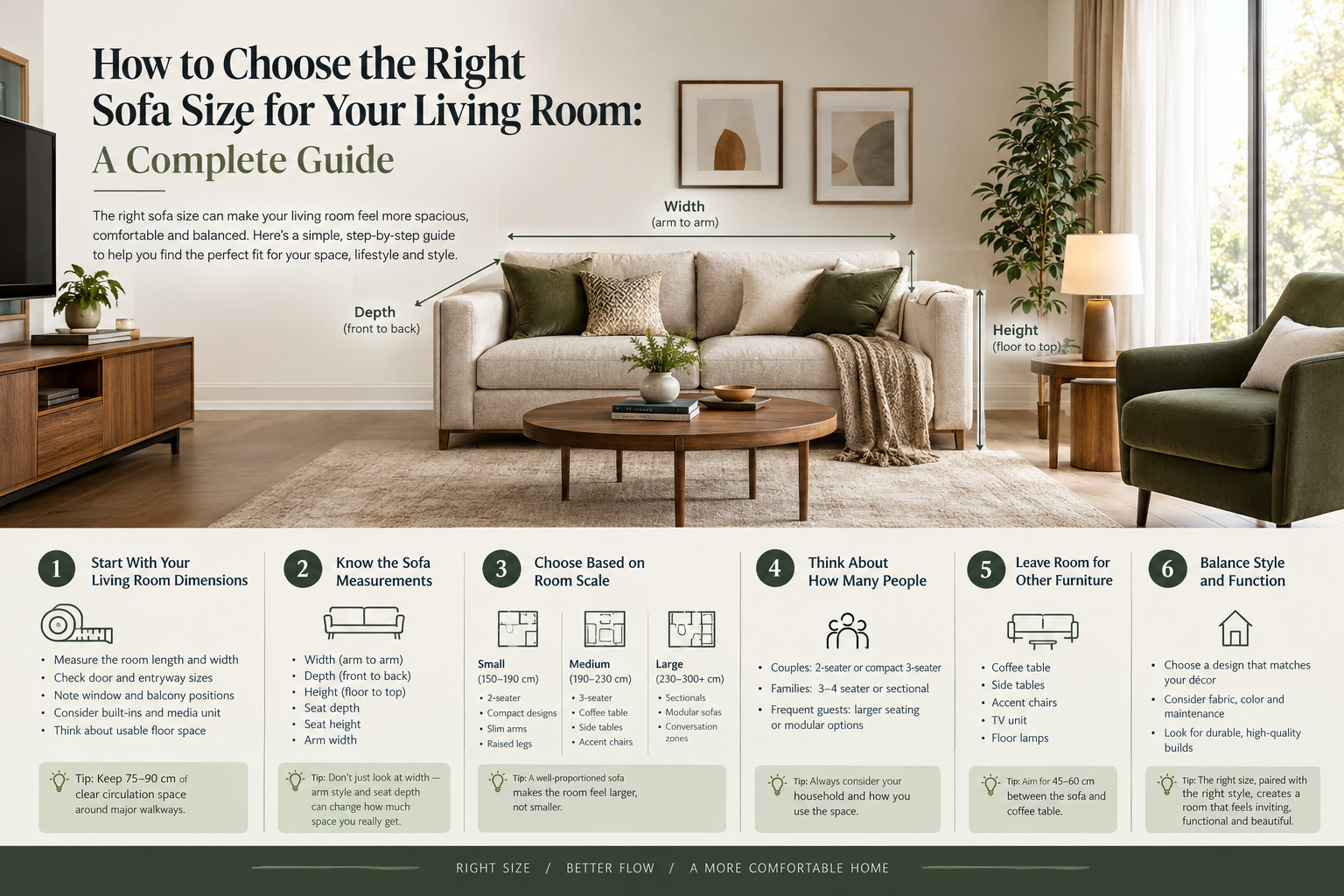
Choosing a sofa is not only about finding a design you like. The size of the sofa can have a major impact on how comfortable, spacious, and balanced your living room feels.
A sofa that is too large can make a room feel crowded, while one that is too small may leave the space looking empty and disconnected. This becomes even more important when you are choosing a sofa for an apartment, compact living room, large family room, or an open-plan home.
Before buying a new sofa, it is worth considering the dimensions of your room, walking space, seating requirements, doorways, furniture placement, and the overall style you want to create.
For homeowners in Bangalore, where apartments and independent homes can have very different room layouts, choosing the right sofa size is especially important.
This guide explains how to measure your space, choose the right sofa configuration, avoid common sizing mistakes, and understand when a custom sofa may be a better option than a standard-sized model.
Why Sofa Size Matters
Your sofa is usually one of the largest pieces of furniture in the living room.
Because of its size, it influences:
- How people move around the room
- How much open floor space remains
- Where other furniture can be placed
- How comfortable the seating arrangement feels
- How spacious the room appears
- How well the sofa works with doors and windows
- The overall visual balance of the room
A beautiful sofa can still feel wrong if its proportions do not suit the room.
The goal is not simply to find the biggest sofa that fits. The goal is to find a sofa that provides the seating you need while leaving enough space for comfortable movement.
Step 1: Measure Your Living Room First
Before looking at sofa designs, measure the room.
Take measurements of:
- Total room length
- Total room width
- Available wall space
- Door openings
- Window positions
- Balcony or passage entrances
- Existing furniture
- Television or entertainment-unit location
- Other fixed elements
Do not measure only the wall where you plan to place the sofa.
Consider the entire room because the sofa will interact with everything around it.
For example, a sofa may technically fit against a wall but prevent a nearby door from opening fully or make a walkway unnecessarily narrow.
Don’t Forget the Entrance
One of the most commonly overlooked factors is getting the sofa into the house.
Measure:
- Main entrance width
- Staircase width
- Lift dimensions
- Corridor width
- Apartment entrance
- Turns and corners along the route
A sofa that fits perfectly inside your living room may still be difficult to bring into the home if the access route is too narrow.
This is particularly important for large sectional and customized sofas.
Step 2: Decide How Many People Need to Sit
Your ideal sofa size also depends on your household.
A person living alone may prefer a compact two-seater, while a larger family may need a three-seater, L-shaped sofa, sectional, or combination of seating options.
Think about your normal usage rather than occasional situations.
Ask yourself:
How many people regularly use the sofa?
Do you frequently have guests?
Do children use the sofa?
Do you want space to stretch out?
Will the sofa also be used for watching television or working?
Your answers will help determine the appropriate configuration.
Choosing Between a 2-Seater, 3-Seater and Larger Sofa
2-Seater Sofa
A two-seater can work well for:
- Compact apartments
- Small living rooms
- Bedrooms
- Home offices
- Guest rooms
- Minimalist interiors
It provides comfortable seating without taking up as much floor space as a larger sofa.
A two-seater can also be paired with an armchair or ottoman if you want additional flexible seating.
3-Seater Sofa
A three-seater is a popular choice for medium-sized living rooms.
It offers more seating while remaining relatively easy to incorporate into many layouts.
It can work well as the primary sofa in a family living room and can be paired with:
- One or two accent chairs
- An ottoman
- A coffee table
- A smaller sofa
- A recliner
L-Shaped Sofa
An L-shaped sofa can be useful when you want more seating without placing multiple separate sofas around the room.
It can work particularly well in:
- Larger living rooms
- Open-plan spaces
- Family rooms
- Television rooms
- Homes where corner space needs to be utilized
However, measure carefully before choosing an L-shaped design.
The longer and shorter sections both need sufficient clearance.
Sectional Sofa
A sectional sofa provides flexibility for larger living areas.
It can create a defined seating zone within an open-plan room and provide generous seating for families and guests.
However, sectionals require careful planning because their overall footprint can be substantial.
How Much Walking Space Should You Leave?
A sofa should not simply fit into the room—it should leave enough space for people to move comfortably.
Before finalizing the design, imagine how people will walk:
- From the entrance to the seating area
- From the sofa to the television
- Around the coffee table
- Toward the balcony
- Between the sofa and other furniture
Avoid creating narrow passages that make the room difficult to navigate.
The exact clearance required depends on the room and furniture arrangement, but the principle is simple: comfortable movement should be part of the sofa plan.
Consider Sofa Depth, Not Just Width
Many homeowners focus only on sofa length.
However, sofa depth is equally important.
A deep sofa may provide a relaxed lounging experience but can take up significantly more floor space.
A shallower sofa may work better in a compact living room where maintaining open space is important.
Consider your preferred sitting position.
Do you prefer:
- Upright sitting?
- Deep lounging?
- Relaxed movie watching?
- A more formal seating position?
Your preferred comfort level should influence the sofa’s dimensions.
Sofa Height Also Changes the Look of a Room
Sofa height can influence how spacious or visually heavy a room feels.
A lower-profile sofa can create a modern, open appearance, while a taller sofa may provide a more traditional or substantial look.
Also consider the height of nearby furniture.
Your sofa should feel visually balanced with:
- Coffee tables
- Side tables
- Television units
- Cabinets
- Chairs
- Curtains
- Wall décor
The objective is to create a coordinated room rather than choosing each item independently.
Think About the Shape of Your Room
Not every living room is a simple rectangle.
You may have:
- Long and narrow rooms
- Square rooms
- Open-plan rooms
- Corner living spaces
- Rooms with unusual wall angles
- Living rooms connected to dining areas
The shape of the room should influence your sofa configuration.
For example, a long narrow room may work better with a streamlined sofa rather than a very deep sectional.
A larger square room may offer more flexibility for an L-shaped or modular configuration.
When Should You Consider a Custom Sofa?
Sometimes a standard sofa simply doesn’t match the available space.
This is where a custom-made sofa can become useful.
A customized sofa allows the dimensions and design to be planned around your specific requirements.
The Sofa Makers specializes in customized sofas in Bangalore and offers different configurations, including corner sofas, sofa sets, recliner sofas, two-seater sofas, three-seater sofas, and sofa beds. The company also describes customization options involving straight, angular, semicircular and modular shapes.
Custom Sofa Can Be Useful When:
You Have an Unusually Shaped Room
If your room has an awkward corner or unusual dimensions, a standard sofa may leave wasted space.
A custom design can be planned around the available area.
You Have Limited Space
Apartment living often requires careful use of every available square foot.
A custom sofa can be designed to fit specific dimensions while maintaining the seating capacity you need.
You Want a Specific Seating Arrangement
Perhaps you want:
- A longer three-seater
- A compact L-shaped sofa
- A sofa with a chaise
- A sofa bed
- A customized recliner arrangement
- Modular seating
Custom manufacturing can provide more flexibility than choosing from fixed dimensions.
You Have Specific Comfort Requirements
Comfort is personal.
One person may prefer firm seating and a relatively upright back, while another may prefer deeper cushions and softer seating.
A custom sofa can be planned around your preferred dimensions, materials, cushioning, and upholstery options.
How to Choose Sofa Size for a Small Apartment
Small apartments require careful planning.
Instead of automatically choosing the smallest sofa available, think about how the entire room will function.
A compact two-seater or streamlined three-seater may work well depending on the room dimensions.
You can also consider:
- Sofas with clean, simple profiles
- Raised-leg designs
- Compact armrests
- Modular seating
- Smaller coffee tables
- Ottomans that can be moved when required
Avoid filling every available area with furniture.
A small room often feels more comfortable when there is visible open space around the major furniture pieces.
How to Choose Sofa Size for a Large Living Room
A large living room presents the opposite challenge.
A small sofa may look lost in a large space.
In a larger room, you can consider:
- Larger three-seater sofas
- L-shaped sofas
- Sectionals
- Multiple seating pieces
- Recliners
- Ottomans
- Accent chairs
You can also create multiple seating zones.
For example, one area can face the television while another can create a conversation space.
The important thing is to maintain balance rather than simply filling the room.
Don’t Forget the Coffee Table
The sofa and coffee table should be considered together.
A coffee table that is too large can make movement difficult.
One that is too small may look disconnected from the sofa.
Before selecting your final sofa dimensions, consider:
- Coffee table size
- Distance between sofa and table
- Side-table placement
- Walking routes
The living room should feel comfortable when all the furniture is placed—not just when the sofa is viewed by itself.
Common Sofa Sizing Mistakes to Avoid
Mistake 1: Measuring Only the Wall
A sofa can fit along a wall and still make the overall room uncomfortable.
Always consider the complete layout.
Mistake 2: Ignoring Doorways
Remember that the sofa has to enter the house.
Measure the route before ordering.
Mistake 3: Choosing Based Only on Appearance
A sofa may look beautiful in a showroom or photograph but feel oversized in your actual room.
Prioritize dimensions as well as design.
Mistake 4: Forgetting Sofa Depth
A sofa can have an acceptable length but still occupy too much floor space because of its depth.
Mistake 5: Not Considering Future Furniture
Think about where you may eventually place:
- A coffee table
- Television unit
- Recliner
- Side tables
- Floor lamps
- Chairs
- Storage furniture
Planning ahead prevents the room from becoming overcrowded.
Should You Buy Ready-Made or Choose a Custom Sofa?
Both options can work.
A ready-made sofa may be convenient when you already know the dimensions and style that suit your room.
A custom sofa can provide additional flexibility when you need specific dimensions, shapes, seating arrangements, materials, or upholstery.
The decision should depend on your room, lifestyle, comfort requirements, design preferences, and budget.
The Sofa Makers provides customized sofa manufacturing in Bangalore, with options designed around individual requirements and room spaces.
A Simple Sofa Planning Checklist
Before finalizing your sofa, check the following:
- Have I measured the living room?
- Have I measured the sofa wall?
- Have I checked door and window positions?
- Have I measured the entrance and access route?
- Have I considered lift and staircase dimensions?
- How many people normally use the sofa?
- Do I need a 2-seater, 3-seater, L-shaped or sectional?
- Have I considered sofa depth?
- Is there enough walking space?
- Will my coffee table fit comfortably?
- Does the upholstery suit my lifestyle?
- Do I need customized dimensions?
Taking a little extra time before ordering can prevent many common furniture-sizing problems.
Create a Sofa That Fits Your Space
The perfect sofa is not necessarily the largest, most expensive, or most visually impressive model.
It is the one that fits your space, lifestyle, comfort requirements, and interior design.
For some homes, that may be a compact two-seater. For others, it may be a spacious L-shaped sofa or a completely customized design.
If you have an unusual room layout or specific requirements, customization can give you greater control over dimensions, shape, seating arrangement, materials, and upholstery.
The Sofa Makers provides custom sofa manufacturing and a range of sofa services in Bangalore, including sofa repair, upholstery, renovation, fabric change, polishing, refurbishing, recliner repair, and customized sofa solutions.
Get a Custom Sofa Designed for Your Space in Bangalore
Planning a new sofa for your home?
Instead of compromising with a standard size, discuss your room dimensions and requirements with a professional sofa maker.
The Sofa Makers can help you create a sofa designed around your space, comfort preferences, seating needs, and preferred upholstery.
Whether you need a 2-seater, 3-seater, corner sofa, recliner sofa, sofa bed, modular sofa, or another customized design, explore your options and create a piece that fits naturally into your living space.
Contact The Sofa Makers today to discuss your custom sofa requirements in Bangalore.
Frequently Asked Questions
1. How do I know what sofa size is right for my living room?
Start by measuring the available floor space and considering walking paths, doors, windows, existing furniture, and the number of people who will use the sofa. The sofa should provide enough seating without making the room difficult to navigate.
2. Is a 3-seater sofa suitable for a small living room?
It can be, depending on the room’s dimensions. Measure the available wall and floor space rather than choosing based only on the sofa’s seating capacity.
3. Are L-shaped sofas good for small apartments?
An L-shaped sofa can work in some smaller apartments, particularly when the room layout allows the corner space to be used efficiently. However, its total dimensions and depth should be checked carefully before choosing one.
4. What is the advantage of a custom-made sofa?
A custom sofa can provide greater flexibility in dimensions, shape, seating configuration, cushioning, upholstery, and design. This can be particularly useful for rooms with unusual layouts or specific space requirements.
5. Can I customize the size of a sofa?
Yes. Custom sofa manufacturing can allow dimensions and design elements to be planned around your specific requirements. The available customization depends on the manufacturer and design.
6. What should I measure before buying a sofa?
Measure the room, available sofa wall, doorways, corridors, entrance, staircase, lift, and other access points. Also consider the position of windows and existing furniture.
7. Should sofa depth be considered when choosing a sofa?
Absolutely. Sofa depth affects both comfort and how much floor space the furniture occupies. A deep sofa may be comfortable for lounging but may not suit a compact room.
8. Can The Sofa Makers make customized sofas in Bangalore?
Yes. The Sofa Makers offers customized sofa manufacturing in Bangalore, including options such as two-seater, three-seater, corner, recliner, sofa-bed and modular designs.
9. Can I choose the upholstery for a custom sofa?
Customization can include upholstery and material choices. The Sofa Makers offers sofa upholstery and fabric-related services alongside its custom sofa solutions.
10. What if my existing sofa does not fit my new home?
If your existing sofa is too large, too small, or unsuitable for your new layout, you can consider repair or modification where practical, or explore a new customized sofa designed specifically for the new space.